

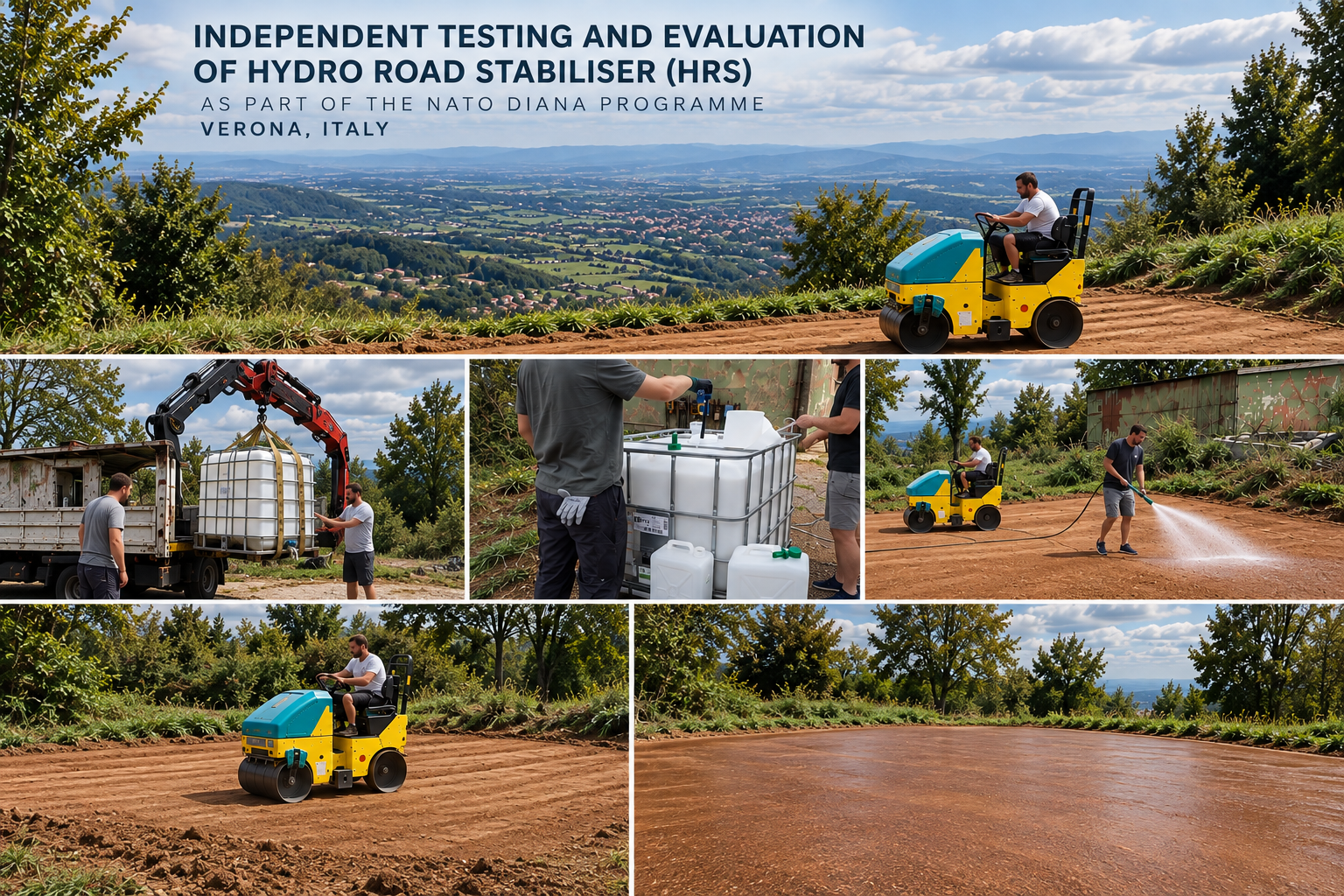

A great opportunity to present Hydro Road Stabiliser (HRS) at the FEG Annual Symposium A big thank you to Forestry England and the Forestry Engineering Group (FEG) for the invitation and for giving Hydro Road the opportunity to share the work being undertaken with HRS. The presentation looked at stronger forestry roads, the environmental advantages of HRS, and the experience gained through the ongoing trial at Sherwood Forest including how the trial has progressed, the lessons learned so far and the work still underway. It was a great opportunity to meet and engage with professionals from across the forestry engineering and wider forestry sector, with some really good discussions around the practical challenges faced in forestry operations. One of the recurring challenges discussed was year-round access. During the wetter months, heavy machinery can remain on site because forestry roads may not provide reliable access for moving equipment in and out. This is an accepted reality of forestry operations and something that has to be factored into planning and productivity. The question is whether it always has to be. Could better performing access extend the working window and give operators greater flexibility throughout the year? These are interesting questions and they give real context to the work currently being undertaken with HRS at Sherwood Forest. The next stages are already underway. ASTM testing is due to begin in Verona (Italy) in two weeks, while discussions are also developing around cold-climate applications, including investigating how the polymer performs in extreme conditions down to -50°C. It was a pleasure to meet and engage with people across the forestry engineering sector and have some genuinely good conversations about the challenges facing the industry and the potential for new approaches. Thank you again to Forestry England and the FEG team for the invitation, the warm welcome and the opportunity to present HRS. The Sherwood Forest trial continues and so does the question: what could be possible if we can extend the boundaries of where and when forestry operations can work? #HydroRoad #HRS #ForestryEngland #ForestryEngineering #FEG #SherwoodForest #RoadStabilisation #ForestryInnovation #SustainableInfrastructure

MILHA is the defence-adapted application of Hydro Road Stabiliser (HRS) a proven civil engineering solution reconfigured for use in expeditionary and infrastructure-limited environments. Built on robust, load-bearing technology, MILHA enables rapid ground stabilisation using in-situ materials. This removes the need for extensive site preparation and significantly reduces reliance on imported aggregates and heavy logistics. Originally developed for civil engineering projects, HRS has demonstrated strong performance in creating durable, long-lasting surfaces. MILHA takes this capability further, adapting it for operational use where speed, efficiency, and flexibility are critical. Key advantages include: Up to 60% cost reduction Up to 60% faster construction Up to 80% lower CO₂ impact MILHA is designed to support mobility, access routes, and temporary infrastructure in challenging environments—delivering reliable performance with minimal logistical burden. Learn more: www.milha-defense.com

Major Milestone Hydro Road Selected for NATO DIANA's Challenge Programme 2026

The 2025 Alarm Survey

BBC Headline Highlights the UK's Ongoing Pothole Problem

We’re thrilled to announce that the Hydro Road website is now live!